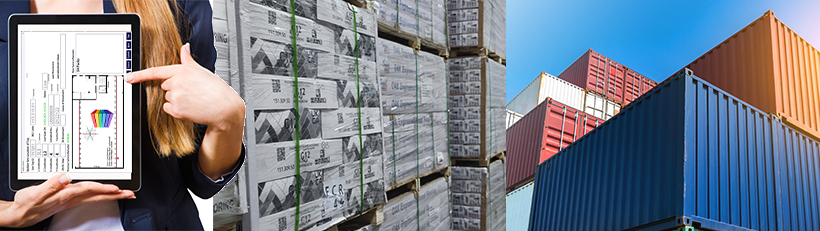
Our I.T. team is shaping the future of our organisation’s warehouse management. Motivation, overcoming challenges, curiosity and, learning from our mistakes it’s just what it takes to create successful innovations. In the past year, we have made leaps in improving our warehouse processes and this is on an ongoing basis.
The Inspiration
Our system was inspired by a Rule-based dynamic container stacking system that optimises yard operations at port terminals. Unlike traditional shelf racking where usually a fixed bin location is assigned. Their system can dynamically track the movement of their container and the subsequent movement of other containers due to that movement. The intricacy of their system runs a seemingly “messy” operation in a state-of-the-art operation.
The Benefit
Traditional racking might provide easy access for pickers, but the aisle space that is needed with the width accessible by a forklift is at an eye-watering of around 50% of the warehouse ground. Our near London-based fulfilment facility with easy access to the M4 & M25 and Heathrow airport means we are paying the premium of having this site. Of course, we see the massive benefit of having this site and it enables our company to facilitate our client in the London hub where a large volume of transactions take place. Having said that, with the business rate and rent cost, we have to find a pioneering way to maximise our storage capacity. More substantial capacity means more lines, better stock availability and lower operational cost per M².
The Implementation
So, it starts with a meeting. We have made numerous suggestions on how we could make that work. It’s our director Sean who gave our team the idea. Sean has vast experience working in seaport cargo terminals and he suggest we could model our warehouse management similar to the dynamic container stacking system they used in the port. Treat the 2200mm pallet as a 45-foot container and our 1200mm pallet as a 20-foot container etc.
Our I.T. team wasted no time and started working on the system, our graphic designers were also drawn in to help the I.T. guys with interface images as well as mapping the warehouse into zones. But the mammoth task is turning every single pallet into a “container”. This was an all-hands-on-deck with our warehouse operative to tag every single pallet and at the same time, we have done a full stock take.
The Outcome
We are pleased to report that after the introduction of our proprietary system and from metrics since our system pass the beta phase. Our KPI on picking efficiency has increased by 14%. Our warehouse holding capacity has increased by 114% which is more than double our original storage capacity.
Our Next Step
Of course, we won’t stop there. We have planned implementation on our next system update. This includes the recommendation to our forklift operator for the minimum movement to get to the goods and the system recommendation of the order of the picking so that the least overall movement of pallets can be achieved. Less movement means higher efficiency and less fuel usage means less CO2 emission. It’s one of the principles of our statement.
This Article is Published on 01 May 2023